
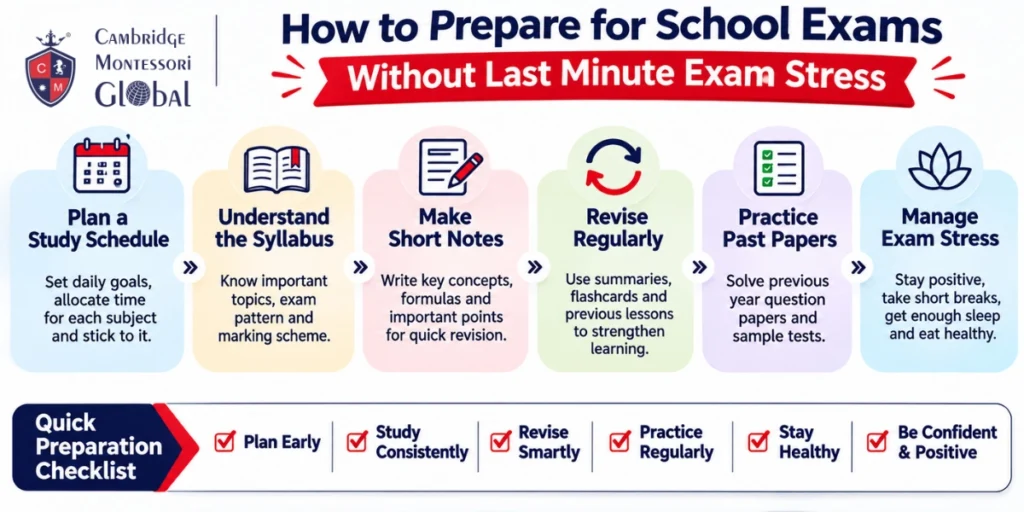
Preparing for school exams without last-minute stress requires early planning, regular revision and a balanced study routine. Students can improve their exam preparation by following a realistic timetable, understanding concepts, practicing sample question papers and maintaining healthy sleeping habits.
With the right exam preparation strategies and support from parents and teachers, children can approach examinations with greater confidence and reduce unnecessary academic pressure. Here are 10 practical tips to help students prepare effectively for school exams.
10 Effective Tips to Prepare for School Exams Without Stress
It is important that students stay organized and follow a realistic study routine. Below are some practical tips to help students be confident with their exam preparation and avoid last-minute stress.
1. Create a Realistic Study Timetable
Students should create a well-planned study timetable to organize their preparation and avoid learning subjects at the last minute. They should list all subjects and chapters that have to be completed before examinations. Every subject should be given dedicated time based on its difficulty level. Students should take short breaks to manage fatigue. It is important to create and follow a realistic timetable which is balanced and makes the day more productive.
Read More: How to Create a Daily Study Timetable for School Students
2. Start the Preparation Early
Students mostly experience stress due to delaying their preparation. Starting studying a few days before the examination creates pressure and leaves very little time for revising concepts. Students should be encouraged to regularly revise their classroom lessons and study a few topics every day as this lets them remember concepts for longer. This also enables students to know which topics they find difficulty and seek help from teachers and parents.
3. Break Large Topics into Smaller Sections
Studying an entire textbook can feel overwhelming. Students should break large topics into simple manageable sections to make studying easier. It also creates a sense of achievement, makes revision more effective and motivates students to study more.
4. Focus on Understanding Rather Than Memorising
Students should focus on understanding rather than memorising concepts, as rote memorisation can make them forget information during exams and leave them unable to explain concepts in more detail.
When children understand basic concepts, they can utilise diagrams, examples and mind maps to explain the concepts. They should also be able to explain concepts in their own words to check their understanding – this lets them become more confident learners.
5. Practise Previous Question Papers and Mock Tests
It is important that students familiarise themselves with previous years question papers and sample papers and understand the examination patterns, question formats and marking schemes. Practicing mock tests under timed conditions improves time management and helps students identify areas that could benefit from additional attention.
After writing a practice paper, students should understand why they lost their marks and improve their academic performance on the exam day.
6. Take Regular Breaks and Avoid Long Study Hours
Students should take short breaks so that their brain can relax and understand concepts much better. Continuous studying can reduce concentration and make learning less effective. The Pomodoro technique, which involves studying for 25-30 minutes, followed by a five-minute break, can be effective. After a few study sessions, students can take a longer break to stretch, drink water or relax.
7. Maintain Healthy Eating and Sleeping Habits
Health influences learning. Going without enough sleep or nutritious food leads to difficulty in concentrating and remembering information. When children eat balanced meals with fruits, vegetables, whole grains and protein-rich foods, they can maintain their energy throughout the day.
Students should ensure they receive 8-10 hours of sleep each day and must avoid late-night study sessions.
8. Keep Distractions Away While Studying
The study space should be quiet and organised, with adequate lighting, comfortable seating and essential stationery. Mobile phones, gaming devices and distractions should be away while studying. An organised study area lets students focus towards their learning goals.
You May Also Like: How to Prepare for Class 10 Board Exams: A Practical Study Plan
9. Stay Positive and Ask for Help
Exam preparation should be dealt without stress or anxiety. They should be treated as opportunities for learning, and not panic, and let students understanding and assess their learning. Parents should encourage children and appreciate them instead of focusing on marks. Positive reinforcement reduces academic pressure.
10. Reserve Enough Time for Final Revision
The days before the examination should be used for revision instead of learning everything from the beginning. Students should utilise this time for important concepts, formulas, definitions, diagrams and notes. They should focus on strengthening their memory and avoid last minute comparisons with classmates.
Conclusion
It is important that students prepare for school exams without any last-minute exam stress and by developing consistent study schedules. They should follow a structured approach with realistic timetables, and aim at understanding concepts through writing sample papers and past year questionnaires. Healthy habits during this time can make a difference in their preparation. Parents and teachers also play an important role in creating a supportive learning environment. Examinations should be viewed as an important part of their education milestones, be dealt with without stress or anxiety and with a balanced mindset.
Frequently Asked Questions (FAQs)
Q1. How can students prepare for school exams without stress?
Ans: Students should prepare early, follow a realistic timetable, and work with taking short breaks. They should ensure their sleep habits and eating habits are healthy.
Q2. When should students start preparing for school exams?
Ans: Students should prepare from the beginning of the academic terms. Regular classroom revision makes it easier to understand concepts.
Q3. How many hours should students study every day for exams?
Ans: The hours of study depend upon the student’s age, grade level and learning requirements. Students should aim at following focused study sessions, with regular revision and breaks.
Q4. What is the best way to create an effective study timetable?
Ans: A good study timetable should include all subjects, learning goals, time for revision and short breaks.
Q5. How can students improve their concentration while studying?
Ans: Students can study in a quiet environment, keep electronic devices away, set small learning goals and take regular breaks.
Q6. How can parents help children prepare for school exams?
Ans: Parents can support students by providing with a comfortable study environment, help with their timetable, and provide emotional support. They should not put excessive pressure on marks.
Q7. What should students do one day before an exam?
Ans: Students should revise important topics, formulas and notes instead of starting new chapters. They should also prepare their stationery and get enough sleep.
Q8. How can students overcome exam fear?
Ans: Students can reduce exam fear by preparing regularly, practising mock tests and taking short breaks. Talking to parents or teachers can also help them feel confident.
Q9. Should students study multiple subjects in a day?
Ans: Yes, students can study multiple subjects by dividing their time according to the syllabus and difficulty level. This helps maintain interest and avoid boredom.
Q10. Why is revision important before exams?
Ans: Revision helps students remember important concepts, identify weak areas, and improve their understanding. Regular revision also reduces last-minute study pressure.