
Class 10 board examinations are an important academic milestone for students. Preparing for these exams requires more than studying for long hours. A clear study timetable, regular revision, subject wise preparation and consistent practice can help students improve their understanding and approach examinations with confidence.
Effective Class 10 board exam preparation begins with understanding the syllabus, identifying challenging topics and allocating sufficient time to every subject. Whether students are preparing for CBSE or another recognized secondary school education board, following a structured study plan can make the preparation process more manageable.
In this guide, students and parents will learn practical strategies for preparing for Class 10 board exams, managing study time, practicing sample papers and maintaining a healthy balance during the examination period.
Understand the Class 10 Syllabus and Exam Pattern
Before starting board exam preparation, students should understand the complete syllabus and examination pattern for each subject. This helps them identify important topics, organize their study schedule and avoid spending unnecessary time on material outside the prescribed curriculum.
Students should:
- Download the latest subject wise syllabus from their respective secondary education board.
- Review chapter wise topics and assessment requirements.
- Understand the question paper structure and marking scheme.
- Identify chapters that require additional practice.
- Maintain a checklist of completed and pending topics.
CBSE students can refer to the official Class 10 Sample Question Papers and Marking Schemes for 2026–27. Students following other boards should consult their respective official academic websites.
Create a 12-Week Class 10 Board Exam Preparation Plan
A well organised study plan helps students divide their preparation into manageable stages. A 12-week schedule can be useful for students who have approximately three months before their examinations.
The plan should focus on completing the syllabus, strengthening concepts and improving examination performance.
Suggested 12-week preparation strategy:
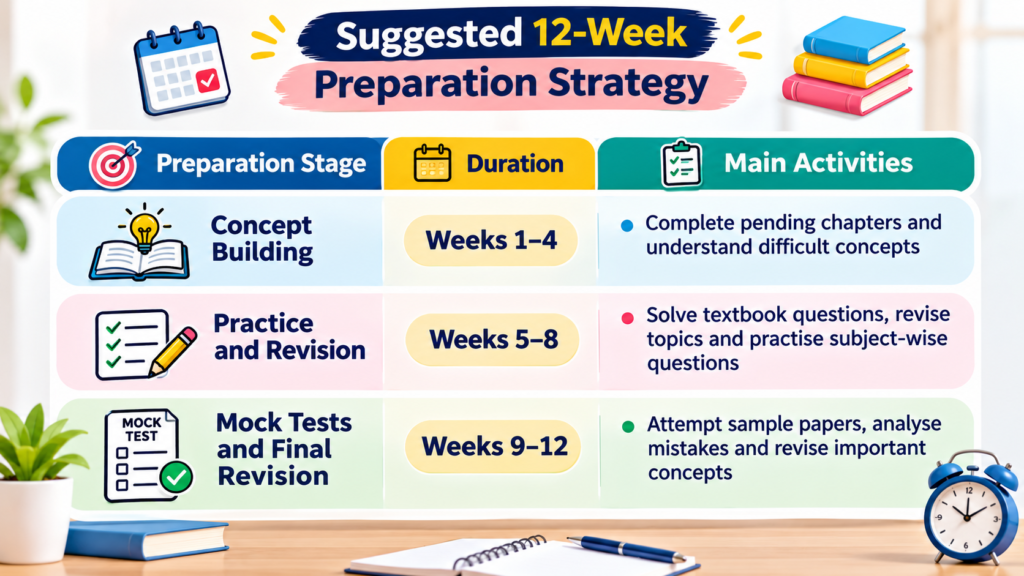
Students who have less preparation time can adjust the schedule according to their requirements while ensuring that revision and practice are not neglected.
Follow a Subject-Wise Preparation Strategy
Every subject requires a different approach. Students should select preparation methods according to the type of questions, concepts and skills involved in each subject.
Mathematics: Focus on Concepts and Regular Practice
Mathematics requires conceptual understanding, accuracy and consistent problem-solving practice. Reading solutions alone is not enough to develop confidence in solving examination questions.
Students should:
- Understand formulas and mathematical concepts before attempting questions.
- Practise problems from each chapter regularly.
- Give additional attention to algebra, geometry, statistics and other challenging topics.
- Maintain a notebook of formulas and commonly repeated mistakes.
- Solve previous-year questions and sample papers under timed conditions.
Regular practice helps students improve calculation accuracy and develop better problem-solving skills.
Science: Understand Concepts and Their Applications
Science preparation involves understanding theories, scientific processes, diagrams, definitions and numerical problems.
Instead of memorising every topic, students should focus on understanding how scientific concepts work and how they can be applied.
Useful preparation techniques include:
- Prepare short notes for important definitions and scientific terms.
- Practise labelled diagrams and understand their functions.
- Solve numerical questions regularly.
- Revise important reactions, formulas and scientific processes.
- Practise application-based and competency-focused questions.
Explaining a scientific concept in your own words is also an effective way to check your understanding.
Social Science: Use Notes, Timelines and Maps
Social Science includes History, Geography, Political Science and Economics. Each section requires a combination of conceptual understanding, factual knowledge and structured answer writing.
Students can make preparation easier by using:
- Timelines to understand historical events.
- Maps to practise geographical locations.
- Comparison tables for important concepts.
- Short notes for definitions and key facts.
- Cause-and-effect charts for historical and economic topics.
Regular answer-writing practice can help students organise information clearly and address all parts of a question.
English and Other Languages: Practise Reading and Writing
Language subjects require regular practice in reading comprehension, grammar, literature and written communication.
Students should focus on:
- Reading unseen passages within a time limit.
- Revising grammar rules and practising exercises.
- Understanding literary themes, characters and important events.
- Practising formal letters, analytical paragraphs and other prescribed writing formats.
- Reviewing spelling, sentence structure and common grammatical errors.
Reading regularly and practising written answers can improve language skills and overall examination performance.
Use Sample Papers and Previous-Year Question Papers
Solving sample papers is an important part of Class 10 board exam preparation. It helps students become familiar with question formats, practise time management and identify topics that require additional attention.
Students should follow a simple practice routine:
- Complete the relevant chapters before attempting a full paper.
- Solve sample papers within the prescribed examination time.
- Compare answers with the official marking scheme.
- Identify questions where marks were lost.
- Revise weak topics and attempt similar questions again.
CBSE students should prioritise the latest official sample papers and marking schemes rather than depending entirely on unofficial predictions.
Sample papers are practice resources, not guaranteed predictions of actual board examination questions.
Prepare a Realistic Daily Study Timetable
A daily timetable gives students a clear direction and helps them distribute their daily study time across different subjects.
Instead of studying one subject throughout the day, students should alternate between subjects that require different types of concentration.
Example of a daily study timetable:
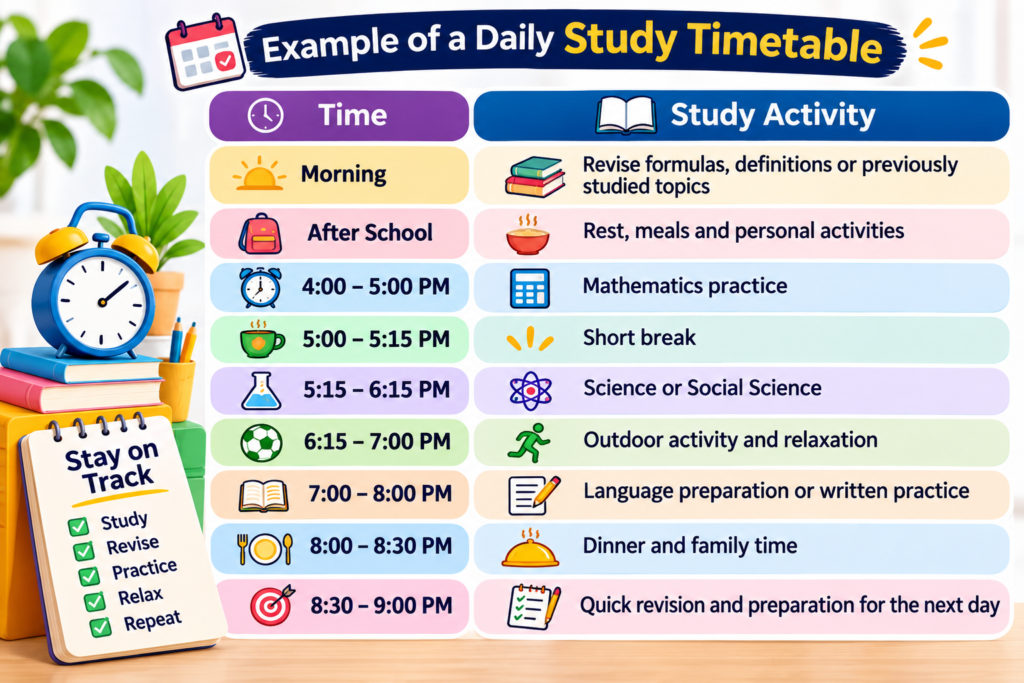
This is an illustrative timetable. Students should adjust their schedules according to school timings, individual learning needs and available study time.
Revise Regularly and Maintain an Error Notebook
Revision helps students retain information and identify concepts that need further attention.
Rather than revising an entire subject only before examinations, students should review previously studied topics throughout their preparation.
Some useful revision techniques include:
- Active recall: Try remembering important concepts without looking at notes.
- Spaced revision: Revisit topics at regular intervals.
- Short notes: Maintain concise summaries of important chapters.
- Self-assessment: Take short tests to check understanding.
- Error tracking: Record mistakes made during practice and revise them regularly.
An error notebook can be particularly useful for Mathematics, Science and grammar exercises because it helps students understand recurring mistakes.
Avoid Common Class 10 Board Exam Preparation Mistakes
Even students who study regularly may struggle when their preparation lacks direction. Avoiding common mistakes can make study time more productive.
Some mistakes students should avoid include:
- Depending entirely on memorisation instead of understanding concepts.
- Ignoring difficult chapters until the final weeks.
- Collecting too many study materials and reference books.
- Skipping revision after completing a chapter.
- Solving sample papers without analysing mistakes.
- Studying continuously without sufficient breaks.
- Comparing personal progress with other students.
A consistent and realistic preparation strategy is generally more useful than last-minute studying or unnecessarily long study sessions.
Manage Exam Stress and Maintain a Healthy Routine
Preparing for board examinations can sometimes create academic pressure. However, students should understand that effective learning also requires adequate rest, physical activity and emotional support.
Parents and teachers can support students by creating a positive learning environment.
Students should:
- Maintain regular sleep and meal schedules.
- Take short breaks between focused study sessions.
- Include physical activities in their daily routine.
- Discuss difficult topics with teachers or parents.
- Avoid unnecessary comparisons and academic pressure.
- Focus on personal progress rather than perfection.
A balanced routine helps students maintain concentration and approach their studies with a positive mindset.
Follow an Effective Strategy During the Final Month
The last month before board examinations should focus primarily on revision, practice and confidence-building.
Students should avoid introducing too many new resources during this period.
A practical final-month strategy includes:
First Two Weeks:
- Revise all completed chapters.
- Review important formulas, definitions and diagrams.
- Practise subject-wise questions.
- Identify and work on remaining weak areas.
Third Week:
- Attempt full-length sample papers.
- Practise writing answers within the examination time.
- Review marking schemes and correct mistakes.
Final Week:
- Revise short notes and important concepts.
- Review examination instructions and required documents.
- Maintain a regular sleep schedule.
- Avoid excessive last-minute studying.
After completing each examination, students should focus on the next subject rather than worrying about answers submitted in the previous paper.
Conclusion
Successful Class 10 board exam preparation depends on consistent effort, clear study goals and regular revision. Students do not need to study continuously for long hours to improve their academic performance. Instead, they should understand concepts, practise questions, manage their time and identify areas that need improvement.
Parents and teachers also play an important role by providing guidance, encouragement and a supportive learning environment.
With a realistic study timetable and a balanced preparation strategy, students can approach their Class 10 board examinations with greater confidence and develop effective learning habits for future academic challenges.
Frequently Asked Questions (FAQs)
Q1. How should I start preparing for Class 10 board exams?
Ans. Start by reviewing the latest syllabus, understanding the examination pattern and identifying difficult chapters. Prepare a realistic study timetable and allocate regular time for learning, revision and question-solving practice.
Q2. How many hours should a Class 10 student study daily?
Ans. There is no fixed number of study hours suitable for every student. Study time should depend on school schedules, learning requirements and preparation levels. Focused study sessions with regular breaks are more useful than studying for long hours without concentration.
Q3. How can I score good marks in Class 10 board exams?
Ans. Focus on understanding textbook concepts, completing the prescribed syllabus, practising previous-year questions, solving sample papers and revising regularly. Pay attention to answer presentation and time management.
Q4. Are sample papers important for Class 10 board exam preparation?
Ans. Yes. Sample papers help students understand question formats, practise time management and evaluate their preparation. Students should also review the relevant marking schemes to understand answer expectations.
Q5. How can students prepare for Class 10 board exams in the last 30 days?
Ans. Students should revise completed chapters, practise full-length sample papers, review important formulas and definitions, and work on weak topics. They should also maintain a healthy daily routine.
Q6. What is the best way to remember difficult subjects in Class 10?
Ans. Use short notes, active recall, mind maps, regular revision and practice questions. Breaking difficult topics into smaller sections can also make learning easier.
Q7. How can parents help children prepare for Class 10 board exams?
Ans. Parents can provide a comfortable study environment, help children maintain a realistic routine, communicate with teachers when necessary and encourage consistent effort without creating unnecessary pressure.
Q8. Should students solve previous-year question papers before board exams?
Ans. Yes. Previous-year question papers provide useful examination practice and help students understand question formats and assess their preparation. They should be used alongside the current syllabus and official sample papers.