
There are several considerations to keep in mind when parents decide to send their child to a particular school. How to Compare Two Schools before Admission looks at this challenge for parents and provides a guide on what they should ask and why each factor matters for the child’s daily development.
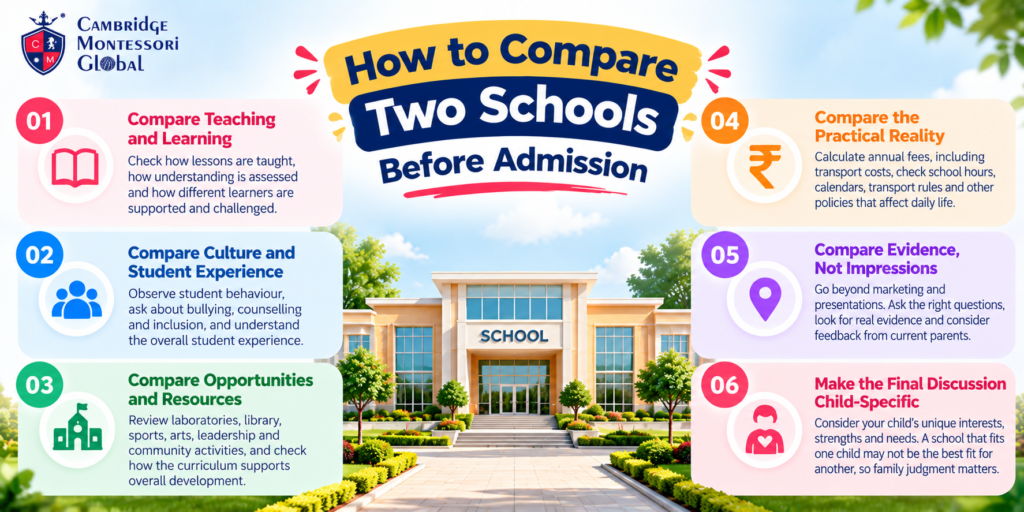
Compare Evidence, Not Impressions
To compare different schools, do not rely merely on first impressions, but turn them into comparable evidence. Categorize questions for schools so that you can look beyond marketing and presentations. Distinguish your observations from what other parents have shared.
Compare Teaching and Learning First
Enquire from schools how lessons are taught and understanding is checked. Parents should request examples of student work. Find out how struggling learners are accommodated and how smarter students are challenged.
Compare Culture and Student Experience
Parents should observe how students interact with adults and whether their behavior is respectful and disciplined. Enquire about bullying, counselling, and inclusion. Enquire how a normal student’s experience is instead of focusing upon the prize winners and toppers experience.
This article is part of our pillar guide: K12 Education: A Complete Guide for Parents and Students.
Compare Opportunities and Resources
Analyze if the school has laboratories, a library, sports, arts, leadership and community activities. Also, review the curriculum to understand how it supports academic learning, practical skills, and the overall development of students.
Compare the Practical Reality
While comparing schools, calculate the annual fees, including transport costs, for each stage of education, from early childhood level to primary level, middle level, and secondary level. Check school calendars, hours, transport rules, and policies that affect daily life. Practical aspects, such as commute time, should also be considered.
Make the Final Discussion Child-Specific
Take into consideration the subjective differences between students. A strong sports program or other beyond academic activities may be beneficial for one student while being irrelevant for another. This is why family judgement matters more than generic rankings.
The Key Takeaway
To compare schools before admission, understand the differences between teaching quality, support, school culture, child wellbeing, facilities, child safety, commute and cost.
Frequently Asked Questions (FAQs)
Q1: What is the most important thing to look for in a K12 school?
Ans: The quality of teaching and the child’s everyday learning environment are important. Curriculum, support, safety, opportunities, commute and affordability should also be considered.
Q2: Should parents choose a school based on board results?
Ans: Results convey useful information but should not be the only measure of school fit. Parents should also consider what students learn, the support they receive, school culture and co-curricular opportunities.
Q3: How can parents judge a school during a visit?
Ans: Parents should observe how teachers interact with students, ask students about their learning and support, request examples of student work, and find out how facilities are utilized.
Q4: What does holistic education mean in practice?
Ans: Holistic education means education beyond academics and including sports, arts, dance, movement, drama and other co-curricular activities.
Q5: What questions should parents ask during a school admission meeting?
Ans: Parents can ask about the daily timetable, homework expectations, parent-teacher meetings, communication methods, school policies, and how the school handles concerns raised by families. These questions help parents understand what their child’s everyday school experience will look like.
Q6: How can parents compare two schools if both seem equally good?
Ans: Parents can create a comparison checklist and evaluate each school against their family’s priorities. Consider the teaching approach, student support, available opportunities, daily routine, and practical requirements. Giving greater weight to the factors that matter most to the child can make the final decision easier.
Q7: Should parents speak to existing students and their families before choosing a school?
Ans: Yes, speaking with current students and parents can provide useful insights into everyday school life, communication, workload, and the school environment. However, individual experiences can differ, so parents should compare these opinions with their own observations and information provided by the school.
Q8: How can parents find out whether a school’s promises match its everyday practices?
Ans: Parents should request practical examples of how the school delivers its teaching approach, student support, and learning opportunities. During a school visit, observe regular classroom activities where possible and ask how stated policies are implemented. Comparing these observations with the school’s claims can help parents make a more informed decision.
Q9: What should parents do if their child prefers one school but the parents prefer another?
Ans: Parents should listen to the child’s reasons and discuss the differences between the two schools together. The child may value friendships, activities, or the learning environment, while parents may focus on other priorities. Considering both perspectives helps families reach a decision that balances the child’s comfort with long term educational needs.
Q10: When should parents start comparing schools before the admission process?
Ans: Parents should ideally begin comparing schools several months before the intended admission period. Starting early allows time to research options, attend school visits, understand admission requirements, compare costs, and ask follow-up questions without making a rushed decision.
References
CBSE – Pedagogical Practices: https://www.cbse.gov.in/cbsenew/pedagogy.html
CBSE – SAFAL Competency-Based Assessment: https://cbseacademic.nic.in/safal/index.html