
For parents looking for a good school for children, the main challenge is in aligning the school’s educational offerings with their child’s educational and developmental requirements. This guide explains the questions that parents should ask, and how each factor matters for a child’s everyday development.
A Good School Is More Than Good Results
When selecting a good school for children, academic performance is a good starting point. While academic results reflect expectations, they do not gauge whether students understand the subjects, receive external coaching or feel supported by teachers. It is better to try to understand the complete learning ecosystem – teaching quality, curriculum, relationships, safety and co-curricular opportunities.
Teachers Who Make Learning Visible
Teachers should clearly explain the course materials, and encourage students to think. Good teachers correct misconceptions and guide students when they are lost. Ask students how classroom quality is monitored and how teachers develop their skills. A good school should make frequent investments in teacher training and professional development of its staff.
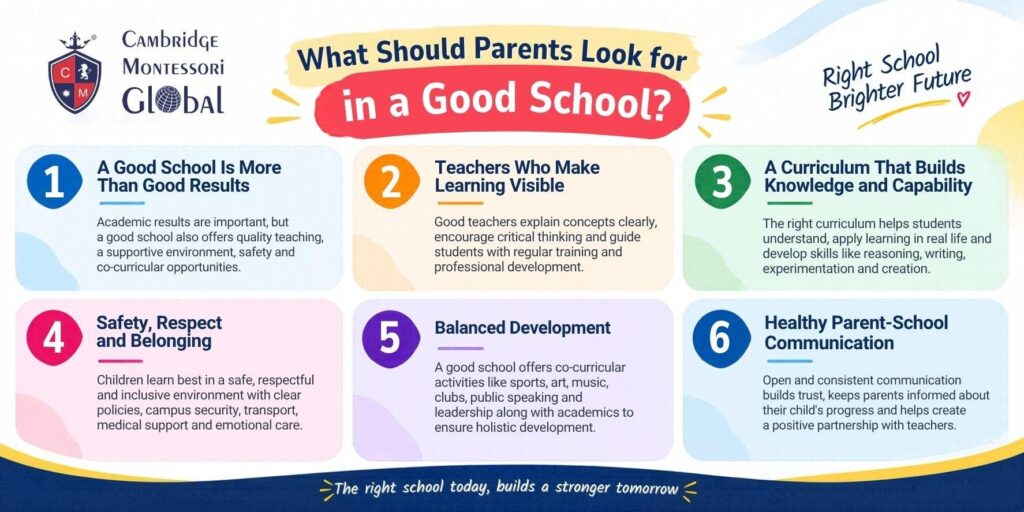
A Curriculum That Builds Knowledge and Capability
The school should select the right curriculum for its students, based upon the level of understanding it imparts and how it encourages students to apply learning in real life. CBSE’s curriculum builds understanding beyond co-curricular knowledge for experiential learning and cooperation.
Parents should try to understand student’s academic work – whether it displays signs of originality or mere copying. Parents should enquire whether students learn skills in reasoning, writing, experimentation and creation. A student’s academic work is a direct reflection of the quality of curriculum being taught.
This article is part of our pillar guide: K12 Education: A Complete Guide for Parents and Students.
Safety, Respect and Belonging
Children need to feel a sense of belonging to their school, failing which they will not be able to learn well. If students are bullied, humiliated or targeting unfairly by other students and teachers, their academic performance deteriorates. Good schools must have clear expectations in place while protecting student’s dignity. They should also provide academic and psychological support, and consider students concerns seriously. Any concerns regarding transport systems, campus security and medical procedures should be clarified, as these are foundational aspects of schooling.
Balanced Development
The school should offer many opportunities beyond academics to ensure holistic development of the children. Co-curricular activities such as sports, art, music, clubs, public speaking, community work and leadership should be encouraged, as these provide students with an opportunity to cooperate with each other and develop confidence. Schools and parents must seek to create a balance between students’ academic and co-curricular activities.
You May Also Like: From Chalkboards to Smartboards
Healthy Parent-School Communication
Schools should endeavor to keep parents informed about events and activities in the school. Communication about the child’s progress should be clear and direct, allowing both parents and teachers to communicate any concerns with each other. Prospective parents should enquire about how concerns are addressed, and who the point of contact is for issues that escalate beyond the classroom level.
The Key Takeaway
Parents should judge a school through a broad set of criteria, including academic results, school culture and curriculum, child’s sense of safety and belonging and the opportunities for balanced development. Parents should keep these points in mind while selecting a school, as a good school affects many aspects of a student’s academic journey.
FAQ’s (Frequently Asked Questions)
Q1: What are the most important things to look for in a K12 school?
Ans: A good K12 school should provide an excellent teaching experience and should ensure that a child’ everyday learning environment is positive and promotes the child’s interests. Aspects of schooling such as curriculum, support, safety, opportunities, travel time and affordability also matter along with academic performance.
Q2: Should parents choose a school based upon academic performance?
Ans: Results should not be the sole criterion for selecting a school. Parents should inquire about the teaching quality, co-curricular activities and school culture as well while making a decision.
Q3: How can parents judge a school during a visit?
Ans: Parents should note the student teacher interactions, ask about the learning and support, request examples of student work, and enquire about how facilities are utilized during a school week.
Q4: What does holistic education imply?
Ans: Holistic education means developing a child’s physical, creative, social, emotional and communication abilities along with academic qualities.
Q5: How can parents check whether a school is recognised and follows an approved curriculum?
Ans: Parents should verify the school’s recognition or affiliation status, the educational board it follows, and whether its curriculum meets the applicable requirements. They should also ask how the curriculum prepares students for future academic transitions and examinations.
Q6: Why is the student-teacher ratio important when choosing a school?
Ans: The student-teacher ratio can influence how much individual attention children receive in the classroom. Parents should ask about class sizes, teacher availability, and how educators support students who need additional guidance or more challenging learning opportunities.
Q7: How does a school measure student progress beyond examination results?
Ans: Parents should ask whether the school uses regular assessments, classroom observations, projects, assignments, presentations, and individual feedback to evaluate learning. Understanding these methods can help parents see how the school identifies strengths, addresses learning gaps, and supports continuous improvement.
Q8: What learning support should parents look for if their child needs additional help?
Ans: Parents should ask whether the school provides remedial support, individual learning plans, counselling, or other appropriate assistance when needed. It is also important to understand how teachers identify learning difficulties and communicate with parents about the support provided.
Q9: What additional expenses should parents consider apart from tuition fees?
Ans: Before admission, parents should clarify the complete fee structure, including admission charges, books, uniforms, transport, meals, technology resources, extracurricular activities, and educational trips, wherever applicable. Understanding these costs helps families plan their budgets and avoid unexpected expenses.
Q10: How can parents understand a school’s approach to homework and screen time?
Ans: Parents should ask how much homework children are expected to complete at different grade levels and how the school balances academic work with rest, physical activity, and play. They should also understand how digital devices are used for learning and what guidelines are followed to encourage responsible screen use.