
Students often rely on timetables to achieve their academic goals. A meticulous and well-planned study timetable is helpful in letting children balance their academic lessons, homework, revision, hobbies, and rest. A timetable lets students avoid procrastination and lets them decide when and what to study, without wasting long hours without a defined goal. It is helpful in making study more organized and efficient.
Start by Understanding Your Daily Routine
Students should start by observing their daily routine and noting down the fixed commitments in the routine, such as school, travel, meals, tuition, sports and bedtime. They organize the remaining time that is left and spend it on homework, revision and independent learning, by honestly documenting how long each activity takes. A plan without adequate time for a break would be difficult to implement.
Students should also note down when they concentrate the best and organize study sessions around that time. It is important to choose a start time that feels the best suited.
Set Clear and Achievable Study Goals
It is important to clarify what exactly is intended to be studied in a subject. Rather than writing “study science,” set a specific goal such as “complete 10 workbook questions” or “revise today’s social science notes.” Setting clear goals helps students identify their progress. The homework that is due should be listed first, followed by topics for revision taught earlier and preparation for upcoming exams. Large tasks should be managed through smaller steps, so that the student is not overwhelmed at once.
Give Each Subject a Suitable Time
Subjects should be paid attention to based on the level of difficulty and practice required for it. A difficult subject would require a longer study session as compared to an easier subject, which may require only a brief revision. The subjects should be rotated to keep the routine evolving. Short sessions which are regularly held are more useful than a last-minute revision a night before the exams. For example, follow an English session with Science reading, or a Maths assignment after completing a language lesson. Primary Program can help students strengthen their subject knowledge through structured learning and regular practice..
Include Breaks, Meals and Sleep
Studying too long with stopping leads to a drop in concentration levels. Students should organize their study in blocks of around 25-40 minutes, followed by a 5 – 10-minute break session. Younger students, especially, should have breaks in their study and have time to stretch, drink water and walk around in between study sessions. Time should be carved out for meals, outdoor activity, family and sleep. Children require a good sleep schedule to support their attention, memory and wellbeing, so timetables should not compromise on bedtime to sustain a study plan.
Create a Simple Timetable
A timetable can be created using a notebook, wall planner or digital calender. The schedule should be easy to read, with one line mentioned for each activity. The subjects can be colour coded in a simple design. Spare time should be left for unexpected homework, difficult questions and tasks.
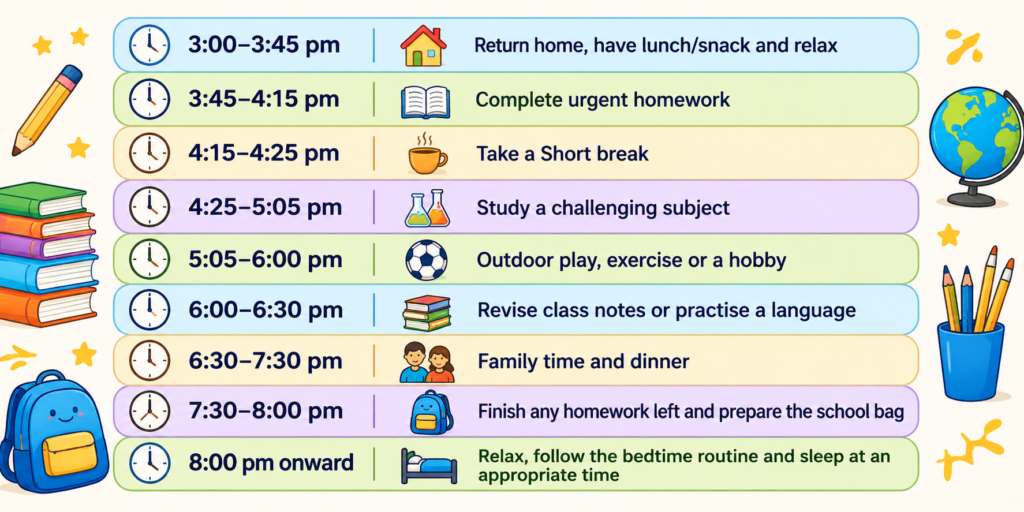
The following example is a timetable is for a student whose school finishes in the afternoon.
Sample Daily Study Timetable
6. Review and Improve the Plan Each Week
The timetable should guide the students into being more efficient. At the end of each week, students should be able to answer which sessions worked well, which tasks took more time and whether enough time to rest was allowed. The schedule should be revised based upon the answers received. In case of a missed session, the task should be moved to a realistic spare slot instead of being fit into one evening. Secondary Program can also support students in organising their learning activities and managing their schedules effectively.
Parents should help the students plan and take ownership of the study schedule. They should praise consistent effort and a well-followed schedule and not compare a child’s timetable with another child’s schedule.
Conclusion
A daily study timetable helps the child build healthy study habits, where they learn to manage their daily work with rest and other responsibilities. Students should begin with a simple plan, set realistic goals, balance subjects, schedule breaks and protect their sleep. Early childhood education also plays an important role in building these foundational learning habits. Organising their day with a timetable helps students become more organized, confident, and independent and helps them achieve their learning goals more realistically.
Frequently Asked Questions (FAQs)
Q.1 How many hours should a school student study daily?
Ans: The studying hours depend upon the age, class level, homework, and individual needs of the learner. A student should concentrate upon the quality of study rather than the number of hours clocked.
Q.2 Should students study every subject every day?
Ans: Not absolutely. Students should pay attention on completing the homework and revision and shuffle subjects during the week.
Q.3 What if a student cannot follow the timetable?
Ans: If a student cannot follow a timetable, it should be adjusted to accommodate the student. Shorter and simpler study blocks should be offered that leave more time as buffer. Learning should not lead to stress for the child.
Q4. How can students create an effective daily study timetable?
Ans: Students should note their daily commitments, set clear study goals, allocate time to each subject, and include breaks and sleep.
Q5. How many hours should a school student study daily?
Ans: Study hours depend on the student’s age, class level, homework, and individual needs. Focus on learning quality rather than total hours.
Q6. Should students study every subject every day?
Ans: No. Students can rotate subjects throughout the week while prioritising homework, revision, and upcoming exams.
Q7. What is the best time to study for students?
Ans: Students should schedule difficult subjects during the time of day when they feel most focused and attentive.
Q8. How long should a student study before taking a break?
Ans: Students can try study sessions of around 25–40 minutes, followed by a 5–10-minute break.
Q9. What should students do if they cannot follow their study timetable?
Ans: They should adjust the schedule, use shorter study sessions, and move unfinished tasks to a realistic spare time slot.
Q10. How can parents help children follow a study timetable?
Ans: Parents can help children plan their schedules, encourage consistent effort, and avoid comparing their timetable with others.