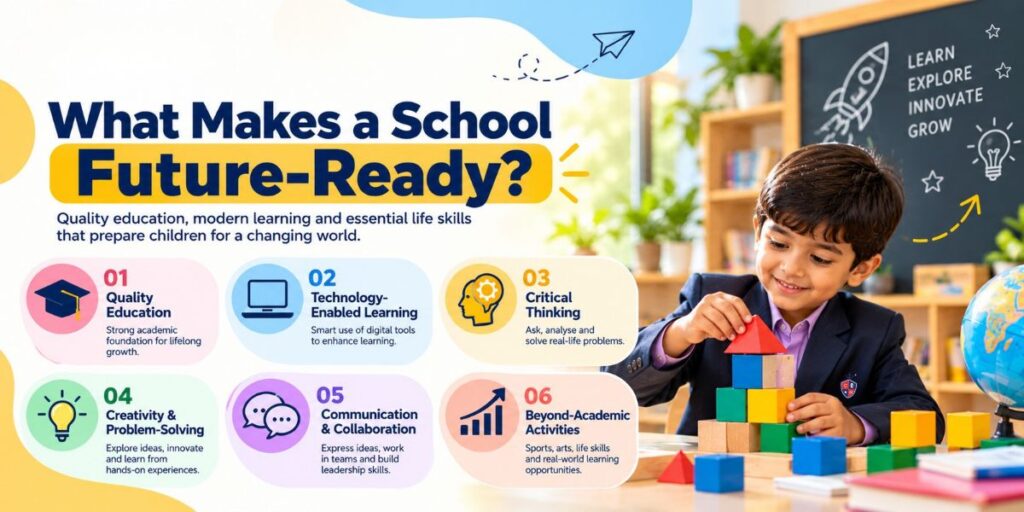
For parents looking for a future-ready school, choosing the right institution involves more than comparing academic results and facilities. They should consider how effectively a school prepares children for a changing world through quality education, technology-enabled learning, critical thinking, creativity, communication, and problem-solving. Understanding the school’s curriculum, teaching approach, beyond-academic activities, and learning environment can help parents make an informed decision about their child’s overall development and future growth.
Future-Ready Is Not the Same as Technology-Heavy
A future-ready school is not necessarily technology-heavy. While it may often be presented as being a school with smart boards, tablets, robotics kits and AI tools, tech hardware alone doesn’t necessarily prepare students for the future. A student using just a pen and paper can display more sophisticated thinking skills as compared to someone who uses an expensive device just to copy information.
Some basic skills such as critical thinking, creativity, communication and collaboration should be in place before students can utilise knowledge effectively.
Competency Matters Alongside Knowledge
NEP 2020 promotes application skills and higher-order skills. Knowledge is not less important, but it is aimed to move beyond rote memorization.
A future-ready classroom would teach students to apply concepts to unfamiliar situations, explain the scientific reasoning and create solutions. Assessment should reflect analytical ability more than memorization.
This article is part of our pillar guide: K12 Education: A Complete Guide for Parents and Students.
Digital and AI Literacy
Students should be taught how to use digital tools, and should also be provided with the judgement to use these tools effectively. They should be able to evaluate sources, protect privacy, communicate responsibly and understand the errors in AI generated outputs. With the widespread use of AI, students now must learn when AI tools are useful and when independent thinking is required. They must understand how to utilize AI tools responsibly.
Creativity, Design and Problem-Solving
Challenges are rarely simple enough to be solved through worksheets. Students should be encouraged to define problems, identify alternatives, build or test ideas, and learn from failures. Spaces such as science laboratories, design studios, maker activities, entrepreneurship, and community projects can support experiential learning while developing students’ communication skills and leadership abilities. Parents can Enquiry for the admission process at Cambridge Montessori Global School to learn more about its educational approach, learning opportunities, and programmes that support students’ overall development.
Communication and Collaboration
Schools can encourage discussions, presentations and clubs, and provide leadership opportunities through them. They can develop among the students’ skills in communication and collaboration, by building their listening and negotiating skills. In group projects, students must learn how to divide work, resolve disagreements and remain accountable for their contribution.
Adaptability and the Habit of Learning
Schools should promote adaptability and the ability to navigate unfamiliar material, because a future-ready student will have to, over time, work with tools and knowledge that did not exist when they attended school. The habit of learning develops when students learn to manage unfamiliar challenges instead of facing predictable tasks.
How Parents Can Identify a Future-Ready School
Parents should enquire how technology is utilised across the primary, middle, and secondary levels, how projects are assessed, where problem-solving skills appear in the curriculum, and how communication skills are developed at each stage. They can also ask for examples of student work and academic progression across these levels. Parents should additionally understand how teachers are trained, as ongoing professional development helps them improve teaching practices and deliver meaningful learning experiences.
The Key Takeaway
A future-ready school provides opportunities for students to develop creativity, communication, collaboration, and adaptability. Cambridge Montessori Global School focuses on meaningful learning experiences that encourage students to explore ideas, develop essential skills, and prepare for future challenges. Technology can support learning, but the quality of educational experiences and the opportunities students receive matter most.
Frequently Asked Questions (FAQs)
Q1: What is the most important thing to look for in a K12 school?
Ans: The most important aspects to consider in a K12 school are the quality of its curriculum, support, safety, opportunities, commute and affordability.
Q2: Should parents choose a school based on board results?
Ans: Results provide useful information about a school’s quality of academics but should not be the sole criterion for judging a school. Parents should also consider how the students learn, the kind of support they receive, the school’s culture and the co-curricular opportunities available.
Q3: How can parents judge a school during a visit?
Ans: Parents can observe student-teacher interactions, ask questions related to student learning, request samples of student work, and enquire how the school’s various facilities are utilized during a week.
Q4: What does holistic education mean in practice?
Ans: Holistic education means considering non-academic aspects of education such as students’ physical, creative, social, emotional, and communication capabilities along with academic aspects of development.
Q5. How does technology help students become future-ready?
Ans: Technology helps students develop digital literacy, research skills, and the ability to evaluate information. When used effectively, it also supports creativity, collaboration, and practical learning.
Q6. Why are critical thinking and problem-solving important for students?
Ans: These skills help students analyse information, understand challenges, evaluate different solutions, and make informed decisions in academic and real-life situations.
Q7. How can schools prepare students for careers that do not exist yet?
Ans: Schools can develop transferable skills such as adaptability, creativity, communication, digital literacy, and independent learning that help students navigate changing career opportunities.
Q8. What role do extracurricular and beyond-academic activities play in future-ready education?
Ans: Activities such as sports, arts, robotics, clubs, and community projects help students develop teamwork, leadership, creativity, confidence, and practical skills beyond classroom learning.
Q9. How can parents support future-ready learning at home?
Ans: Parents can encourage curiosity, independent thinking, reading, creative activities, responsible technology use, and discussions that help children explore ideas and solve everyday problems.
Q10. Why is teacher training important in a future-ready school?
Ans: Continuous teacher training helps educators adopt effective teaching methods, understand emerging technologies, and create engaging learning experiences that meet students’ changing needs.
Sources / Editorial References
CBSE – Pedagogical Practices: https://www.cbse.gov.in/cbsenew/pedagogy.html
CBSE – SAFAL Competency-Based Assessment: https://cbseacademic.nic.in/safal/index.html